Wednesday, May 19, 2010

Dir'iyyah

A few days ago, Mark and Debbie (my friends and neighbors) took me to "Old Riyadh" also known as Al-Dirah. The town was founded in 1446, but reached its peak in the 18th century, until the Ottoman Empire sacked the city in 1818.

I got some great pictures:


The city wall:


Here is a giant Saudi flag. They are creating a tourist spot here. Between the flag and me, there is a valley where tradition has that Mohammad ibn Abdul Wahhab is burried. Wahhab's created a very conservative sect of Sunni Islam that still has a great influence over Saudi Arabia today. Wahhabism is linked to both the Mutawwa (religious police) and terrorism. The relationship between Saudi Arabia and conservative Islam is complex. Abdul Aziz used the Wahhabi religious fighters (Ikhwan) to consolidate his power in Saudi Arabia (1920s). Later, when they revolted accusing him of religious laxity, he got permission from the religious council to slaughter them (1930). Abdul Aziz renamed the region Saudi Arabia and appointed himself King (1932). Saudi Arabia was still a backwater fighting wars on the backs of camels, then in 1938 oil was discovered and the country was changed forever.


Here is a great picture of Debbie and me. We are inside the city with the wall behind us.

Sunday, May 16, 2010

Memories of Gene

A Wonderful Slide Show of Memories of Gene:

Here is Gene's obituary.

Saturday, May 15, 2010

Oil Spill Theory

My previous post on the spill lead to a little bit of thinking about oil spills. The current law is a bit strange, and I'm not sure I really understand it. It sounds like this law limits the damages that can be attained in Federal court to $75 million and that includes removal costs, damages to both public and private property and resources, lost tax revenue, and lost profits. According to this, there is still unlimited liability in state courts. Can the U.S. government sue a company in a state court? Can the state government? My guess would be that the local businesses can still sue in state court, but the taxpayers would get screwed under current law. If anybody knows more, please comment.

What I want to focus on is the Oil Spill Liability Trust Fund. Basically, a 5 cent per barrel tax on oil was created and put in a fund to clean up future oil spills. The fund can provide $1 billion dollars for oil spill cleanup. So, what the government basically created was an insurance fund paid for by oil consumers to clean up oil spills. It's still funded by taxpayers, but not by the income, rather, by their consumption of oil. So in a sense, it's a good thing. The people that benefit the post from off-shore drilling (whoever they are) are buying insurance for taxpayers as a whole. The problem is that with insurance the incentive to be diligent goes down. The driller is no longer paying the cost of the clean up. Of course, the response should be oversight. Unfortunately, the regulator of this was completely corrupted. I encourage everyone to check out Rachel Maddow document the extent of this corruption that I happened to catch at breakfast.

One response is that we need better regulators, and to the extent that is feasible, there is no doubt that would help. Unfortunately, a critique of that is that the nature of government is to get compromised by industry. Economists often call this "rent seeking." So what is another possible answer? Well, we could mandate firms buy a billion dollars of insurance. Then we don't need to worry about the government to be the oversight, we can work through the market. Let Warren Buffett (or whoever) collect premiums and audit safety as the insurer has an incentive not to make large payouts. This really just pushes the problem one stage back though, because now we have to regulate the insurer to make sure they can actually provide insurance. Otherwise, I'd be happy to sell the insurance to oil companies collecting revenues for doing nothing and declaring bankruptcy if the big spill came.

What I find interesting is that this is the exact same predicament that we are going through with the financial reform bill the Democrats proposed. Basically, we are insuring the banks against future bailouts by collecting a tax on banking. In this case, the fallout of financial failure is equivalent to an oil spill. It takes out a lot of industries just chillin in the surrounding waters. It's not clear which model is better. The first one has worked for a long time with the FDIC and member banks and deposit insurance. But it also looks really bad when the regulators look really bad. The second model works well on a small scale. I have to buy insurance for the benefit of other drivers I might hit with my car, but it's unclear if it scales all the way up. If payoffs are large and rare, collecting premiums with no intent to be able to payoff if the big one comes looks more and more appealing.

Friday, May 14, 2010

Republican Corporatism

My political views are somewhat interesting compared to my peers. I tend to care more about freedom and economic growth than most of my peers, and yet, they are all Republicans and I increasingly despise the GOP.

Paul Krugman gives a good example of why:

"In the wake of last month’s catastrophic Gulf Coast oil spill, Sen. Lisa Murkowski blocked a bill that would have raised the maximum liability for oil companies after a spill from a paltry $75 million to $10 billion. The Republican lawmaker said the bill, introduced by Sen. Robert Menendez (D-NJ), would have unfairly hurt smaller oil companies by raising the costs of oil production. The legislation is “not where we need to be right now” she said."

The backbone of the free-market response to corporate irresponsibility is that they can be sued by people for damages they caused. In fact, with immunity from these suits or a cap on them, we should expect companies to cut corners and take on a lot of risk. The whole purpose of a firm is to maximize profits, and in a competitive market even if one firm leaves money on the table another will scoop it up.

The effect of any cap on damages at all is that after some point the federal government subsidizes oil spills. We are actually incentivizing oil spills. I haven't seen a more general Republican response to this, so maybe this is a rogue Senator from Alaska under all the pressure of Alaskan oil interests. I just did a search and here are some Republicans offering a bill that appears to greatly increase the liability cap, but I don't know the specifics.

Wednesday, May 12, 2010

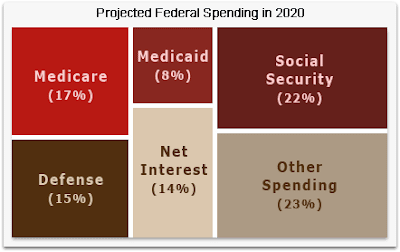
The U.S. Budget


From Harvard economist Greg Mankiw's blog. It's a good picture, because it starts to get at why cutting the budget is so difficult. A lot of people think we just need to cut out "pork," but even the anti-pork watchdogs only estimate pork at .5% percent of the budget. So what else is in "Other spending"? A whole lot of it is in stuff people think government should do transportation, energy, treasury, health and human services...

The point is the budget doesn't look very good. And all cuts are painful. Twenty-nine percent of your taxes (actually much more, unless you have a high income) go to pay your grandparents social security and medicare. Fourteen percent goes to interest payments on debt your parents accrued. It's kind of funny to me that so large a proportion of the tea party movement is older people, who get socialized medicine and social insurance payments, when forty-three percent of the budget either goes straight to old people or to interest on debts they accrued by running deficits.

And don't forget old people vote like crazy (what else do they have to do), so most of these programs are untouchable.

Softball Champs!!!

In an amazing upset, the Scorpions went on an improbable run to win the softball champion. We were the 5th seed of 8 teams. In a double elimination tournament, we won the first game and got run-ruled by the one seed. We had to win a double header against two teams we had split with earlier in the season. Then, we had to beat the #1 seed twice, a team that had already run-ruled us three times previously. They had a 13 and 1 regular season record, compared to ours of 5 and 8. If you laid me 20 to 1 odds, before the first game, I don't think I'd have taken them. Somehow we beat them, though. We hit like crazy, made less mistakes in the field and came out on top. We won the first game 30 to 25 and run-ruled them the second game 25 to 10. I finally got a chance to breakout going 7 for 7 with three doubles and 4 singles in the championship. I hit the ball pretty well and also got some breaks I hadn't gotten earlier in the season, a hard ground ball got through and two texas leaguers landed safely.

I can't really describe how much fun it was to win. We were all pretty sore and exhausted playing four games in two days, and I kind of thought losing was inevitable even when we started the last game. When we finally pulled it out, I actually teared up. It was just amazing to work hard and win something. It's probably been 8 years, since I played in a meaningful sporting event. Lots of fans showed up for both teams, which really added to it all. Someone I've never even seen before came up to me after the game and said, "Charlie, I think you might be the MVP. You had seven hits and four doubles!" (he counted one that was really a single with an error). I didn't agree, but it was really fun that people noticed I'd had a good game.

All in all, it was a great season. I made a bunch of great friends and had a really great time. We even had a party and award ceremony the next day. Woot! Go Scorpions!

Tuesday, May 11, 2010

Green Jobs

There's always been a lot of confusion around climate change and green jobs, not least of which is propagated by the administration, but listening to some otherwise seemingly knowledgeable business people discuss it on multiple CNBC type shows, it's apparent that the confusion is not just politically motivated obfuscation.

There are two basic narratives that tend to get argued.

1. Climate change is a wonderful opportunity to create green jobs, and creating jobs spurs economic growth. Yay!

2. Climate change is a terrible, unbearable toxic drain on our economy that will cause higher taxes that will hurt the economy.

Both views have bits of truth and bits of confusion. The best way to think about climate change is analogous to a giant meteor hurdling towards the Earth. Many scientists expect the meteor is expected to hit the Earth in about 100 years. But there's lots of problems. The meteors far away, so it's not totally clear when it will actually hit the Earth or how much damage it will due. It's not clear we even know for certain it will hit us at all. What if we there are gravitational fields we don't know about that will save us or objects we don't know about that will change its course.

So, we decide to start preparing just in case, which is pretty reasonable if you think the probability is high enough or the worst case scenario is bad enough. We get scientists and engineers to try to create new meteor stopping technologies. We employ construction workers to build some of their designs. Jobs are created. But it should be obvious that the best case scenario would be not to have to ward off the meteor attack. We'd rather have those workers doing other things, I mean, otherwise we could just sign a treaty with China to have nukes fire at each other in 100 years and spend a bunch of money trying to figure out ways to stop them.

But it should be just as obvious that the second view is wrong. The meteor IS coming. The "meteor jobs" and taxes aren't a drain on the economy; the meteor is. I understand that if you think the meteor is a low probability event or won't be that bad, you won't want to spend much stopping it, but then your argument should be about the probability of the meteor hitting, not the cost of the taxes.

There's a final argument that says. I think the meteor is coming, but I just want to let the free market decide how to stop it. It's actually possible that would work, but it could also fail. People's best strategy is to donate as little as possible, but still have the meteor stopped. So inevitably less resources go into the project, it might still be enough, but it might not. I've heard people state this argument, but I've never heard them articulate why its a good trade-off to make.

This analysis leaves open all possible views for what we should do about climate change (or meteor attacks), but there are coherent arguments and incoherent arguments, let's argue better.